
Recurring Roof Leaks: Causes and Fixes in Renovation
A roof leak that keeps coming back is rarely solved by patching. Learn the causes, how to trace the water path, and how to fix it properly during a renovation.
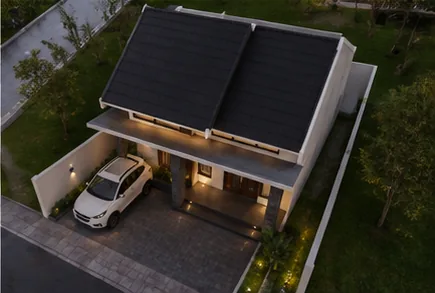
A roof leak that returns every rainy season almost always means the real source has not been addressed. Where water drips from the ceiling is rarely where it enters. A renovation is the right moment to trace that water path properly and fix it as part of the design, not with another patch.
Why patches rarely last
Rainwater follows slopes, gaps, and framing. It can enter near the ridge, travel along the purlins or across the ceiling void, and drip several metres from where it came in. If only the visible wet spot is patched, the original entry point stays open.
The patching materials are the second issue. Sealants and waterproof coatings age under heat and UV. Without correcting the junction detail itself, they only delay the problem by a season or two.
Common causes of recurring roof leaks
In older houses across Greater Jakarta, leaks usually come from a handful of points that can be checked one by one:
- Roof-to-wall junctions. Where a roof meets a taller wall, it needs flashing, a sheet that laps over the joint and sheds water outward. Junctions finished only with cement mortar crack easily.
- Gutters and valleys. Undersized, clogged, or poorly jointed gutters overflow in heavy rain. Valleys, where two roof planes meet, carry the largest volume of water.
- Insufficient pitch. Each roofing material has a minimum slope set by the manufacturer. A roof that is too shallow lets wind-driven rain push back under the tiles.
- Cracked, shifted, or under-lapped tiles. Vibration, earlier works, or sagging framing can disturb the roof covering.
- Sagging framing. Decayed timber or light steel framing that was not properly engineered makes the roof plane uneven and creates ponding.
- Roof penetrations. Openings for vent pipes, solar water heaters, or cables are often sealed as an afterthought.
- Concrete flat roofs. Hairline cracks, worn waterproofing, or blocked rainwater outlets let water pond and seep through.
Roof leaks are often linked to damp walls below. If you see both, also read our guide on damp walls and seepage during renovation.
Tracing the source before choosing a fix
A measured repair decision starts with data. During Project Discovery, the team should gather the following:
- Leak history. When it appears, in what kind of rain, and what repairs have been tried.
- Stain mapping. Photograph and mark every stain on the ceilings and walls on a simple floor plan.
- Inspection from above and below. Check the covering, gutters, and junctions, then open the ceiling to follow water trails on the framing and boards.
- Water testing. Wet specific areas in stages to isolate the source. For concrete flat roofs, a ponding test typically runs for 24–48 hours.
- Framing condition. Look for sagging, corrosion, termites, and weak connections.
The findings are documented as part of reading the existing condition, an approach we explain in more depth in old house renovation risks.
Three levels of solution: local repair, re-roofing, or redesign
Local repair
Suitable when the source is clear and contained, such as loose flashing, a cracked tile, or a blocked gutter. The cost is relatively small, but it still needs the correct detail rather than another layer of sealant.
Replacing the covering and underlayer
When leaks are widespread and the covering is old, re-roofing is often the more sensible choice. It is also a chance to add a waterproof underlayer and thermal insulation, which improves comfort in a tropical climate.
Redesigning the roof geometry
If the root cause is a shallow pitch, too many valleys, or complicated roof intersections, detail fixes will not be enough. The roof form needs simplifying or its pitch adjusting. This affects the elevation and the structure, so it should be coordinated by the architect and the structural engineer.
This matters even more when the renovation includes an extension, because the joint between old and new roofs is a common leak point. If you are planning to build upward, read what to assess before adding a floor.
Controlling cost and quality on roof works
Roofs often reveal new findings once opened up, so the controls should be agreed at the start:
- A detailed RAB and BOQ. The RAB (the Indonesian construction budget) and BOQ (bill of quantities) separate roof covering, framing, gutters, flashing, and waterproofing, so you know exactly what is in scope.
- Contingency. For older houses, a contingency of around 10–15% is commonly set aside for findings such as decayed framing.
- Variation orders. Changes caused by site findings are priced and approved before work proceeds. See when variation orders are normal.
- Testing and punch list. Once complete, the roof is water-tested or monitored in rain. The punch list, a list of items to correct before handover, records anything not yet right.
- Maintenance period. Leaks that appear during the maintenance period are handled according to the contract.
These controls follow our four-phase process, with an approval point at the end of each phase. Details are on our process and safeguards page.
When roof repair belongs in a full renovation
Roof works are best combined with a larger renovation when the framing needs replacing, the roof form is changing, or the interior below will be refurbished. Working on the roof after new ceilings and finishes are installed risks damaging work you have already paid for. The right sequence is roof and structure first, then services, then finishes.
In our full home renovation service, the roof is treated as part of the building system: structure, rainwater drainage, insulation, and appearance are designed together and included in the same estimate.
Frequently asked questions
Is a waterproof roof coating enough to stop leaks?
Coatings can help on concrete flat roofs or with hairline cracks. If the source is a junction, the pitch, or the gutters, a coating only postpones the problem.
Does the whole roof need to come off?
Not necessarily. It depends on what tracing the water reveals and on the condition of the framing. Many cases can be solved with detail repairs or partial replacement.
When is the right time to fix the roof?
Inspection is most useful during or just after rain, when water paths are visible. The works themselves are best scheduled outside the peak wet season, with temporary protection whenever the roof is open.
If your roof keeps leaking and you are considering a renovation, the next step is a documented reading of the existing house. You can request an initial project review so we can understand your home, scope, and priorities before recommending a solution.